
If you’ve spent much time at Summit, you’ve probably noticed that we have a lot more than just walls for climbing training.
Along with all of the normal gym equipment you’d expect to find at a climbing gym, we have some pretty unique tools specifically designed to help climbers train. Some of them are probably familiar, like hangboards, while others might make you stop and wonder what exactly a giant bucket of rice is doing in a climbing gym.
I’ve been making posts about some of these pieces of equipment, and they’ve made me realize just how many different ways there are to train for climbing. Here are some of my favorite pieces of unique climbing training equipment we have at Summit and what you can actually use them for.
Climbing Training Tool #1: The Pinch Machine
The pinch machine is probably one of the more unusual pieces of equipment you’ll find at Summit. It originally comes from the arm lifting world, but it has a pretty obvious application for climbers: getting better at pinching.
Pinches are a type of climbing hold where you use your fingers on one side and your thumb on the other. They show up all over climbing, but they can be especially important on certain types of rock. Coach Patrick actually used the pinch machine while training for a climbing trip to Kalymnos, an area known for its limestone tufas and the continuous pinching that comes with climbing them.
When you use the pinch machine, the goal is to make the pinch itself do the work. Keep your fingers straight and focus on squeezing your thumb toward your middle finger. Keep your arm straight and positioned similarly to how it would be while climbing, and avoid leaning your body into the machine to create more force.
It’s a pretty simple movement, but it gives you a way to specifically train something that can be difficult to isolate during a normal climbing session.
Using a Rice Bucket for Climbing Training
A bucket full of rice might seem like a strange thing to have in a climbing gym, but the rice bucket is actually a pretty classic training tool.
The basic idea is simple. The rice provides resistance as you move your hands, fingers, and wrists through different movements. You can use it for a variety of drills that work the muscles and tissues of your hands and forearms.
For climbers, I think of the rice bucket as more of an accessory movement than a replacement for climbing or more specific finger strength training. It can be a simple way to build some additional stamina and endurance in your hands and forearms without needing a complicated setup.
How you use it can also change how challenging it feels. Moving your hands faster will generally create more resistance and can give you more of a pump, while slower movements can be used to focus on control.
The Systems Board
Our systems board is one of my favorite pieces of equipment for practicing climbing movement.
A systems board is a climbing wall that is symmetrical down the middle. The holds on one side have a matching setup on the other side, which makes it possible to practice the same movement in both directions.
This is useful because we all have natural movement preferences. You might be really comfortable reaching with your right hand or turning your body one direction but feel much less coordinated when you have to do the same movement on the other side. The systems board gives you a way to work on that.
One way to use it is to create a sequence on one side of the board. Climb through it, memorize the movements, and then try to climb the exact same sequence on the other side. The goal isn’t just to get to the top. You want to mirror the movement as closely as possible.
This can help you notice differences in strength, coordination, and movement between your two sides. Systems board training is specifically useful because you’re still practicing actual climbing movement while making those differences easier to identify.
The Traverse Wall
The traverse wall is another piece of equipment that might not look particularly exciting at first, but it has a lot of uses. Instead of climbing up, you climb sideways.
The wall stays only a couple of feet off the ground, which makes it a really approachable place for newer climbers to practice skills without having to worry about being high off the ground. It’s a great place to work on things like footwork, body positioning, and movement.
It’s also useful for more experienced climbers. If you’ve ever tried to do a long endurance workout on a normal climbing wall at a busy commercial gym, you know that it can be difficult to stay on the wall for very long without getting in someone’s way. A traverse wall gives you a dedicated space where you can keep moving for much longer.
It’s also a great warm-up tool. You can use it to gradually get your body moving before you start climbing harder routes or spend some time practicing specific movement skills.
There are a lot of climbing skills that are difficult to practice in a typical gym without a traverse wall or spray wall. Being able to climb sideways for an extended period gives you a different way to practice movement and endurance than you might get from a normal climbing session.
Hangboards
Hangboards are probably the most recognizable training tool on this list.
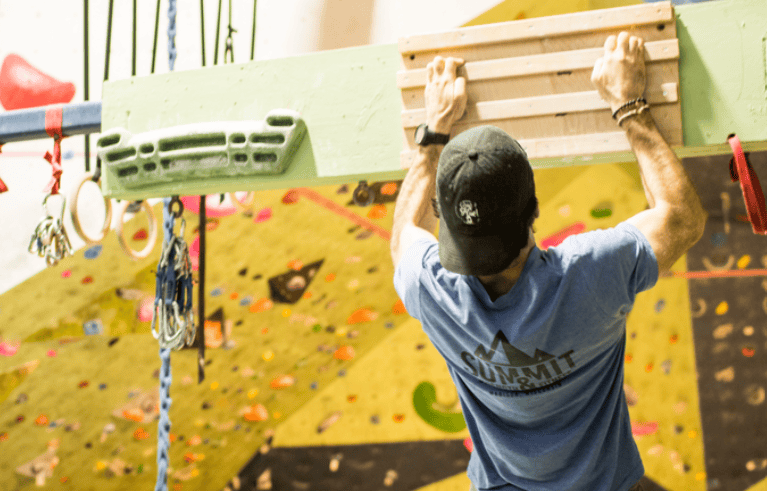
They’re designed specifically for training finger strength, and Summit has five different hangboards along with two or three campus boards that can be used for a variety of climbing training exercises.
There are a lot of different ways to train on a hangboard depending on your experience and goals. You can work on different types of grips, change the amount of weight you’re using, or adjust your hang and rest times to make a workout easier or harder.
If you’re newer to climbing, though, don’t feel like you need to immediately start hangboarding just because you have access to one. Hangboarding puts a lot of load through your fingers, and it makes sense to build a solid climbing foundation before jumping into more intense finger training.
We’re also working on a more in-depth hangboard guide for anyone who wants to learn more about how to use them.
In the meantime, we have two hangboard training plans available through our training plan store. One is designed more for beginners and the other is geared toward intermediate climbers. If you’re interested in getting started with hangboard training but aren’t sure where to begin, those can be a good place to start.
The Roof
And then there’s the roof.
Our cave at Summit has a roof section that allows climbers to actually top out, which is a pretty unique opportunity to practice something that can be intimidating when you first encounter it outside.
Topping out can be one of the scarier parts of outdoor climbing. You’ve spent the entire climb moving upward, and then suddenly you have to figure out how to get yourself over the top of the rock.
For newer and youth climbers at Summit, topping out for the first time can be a pretty big milestone. There’s something about pulling yourself over the top of a wall that feels a little scary and exciting at the same time.
The roof is also a great place to practice overhang climbing. Good footwork becomes especially important when you’re climbing steep terrain and learning how to keep your feet engaged can make a huge difference in how long you can stay on the wall.
Another nice thing about our roof is that the routes often stay up longer than other routes around the gym. That gives you more time to work on a problem, figure out the movements, and come back to it later to see if you can make progress.
Try Something New in Your Climbing Training
One of my favorite things about Summit is that there are so many different ways to train. You can climb routes, lift weights, work on your finger strength, practice movement, train your endurance, or spend some time working on a skill that you know is holding you back.
And you don’t have to be an elite climber to use all of this equipment. There are different ways to approach almost all of these tools depending on your experience and what you’re trying to improve.
If you’ve walked past the pinch machine wondering what it does, stared at the rice bucket wondering why anyone would voluntarily put their hands in it, or looked at the systems board and thought, “What am I supposed to do with that?”, come give them a try.
There’s a lot more to climbing training than just climbing harder routes, and Summit has plenty of equipment to help you explore all of it.